
Your brand no longer exists only in the minds of customers, journalists, investors, employees, and other human stakeholders.
It also exists inside AI systems.
Every day, people ask ChatGPT, Claude, Gemini, Perplexity, and Grok questions about companies, products, executives, industries, controversies, and competitors. These systems retrieve, interpret, and compress information from across the internet into direct answers.
The result is a new layer of brand perception.
AI systems are forming conclusions about which companies are innovative, trustworthy, risky, differentiated, growing, declining, or credible. Those conclusions can influence how customers evaluate products, how journalists research stories, how investors understand markets, and how employees assess potential employers.
For communications leaders, the question is no longer simply:
“What is the media saying about us?”
It is also:
“What are AI systems learning from those stories, and what will they tell people who ask?”
AI brand perception is built from narratives
AI systems do not understand a company one article at a time.
They synthesize patterns across many sources.
A single announcement may have little lasting effect. But when the same claim appears repeatedly across authoritative publications, company materials, analyst commentary, executive interviews, industry reports, and other credible sources, it can become part of the durable narrative surrounding a brand.
Those narratives might include:
The company is a leader in artificial intelligence.
The company is losing ground to a faster-moving competitor.
The company is trusted by enterprise customers.
The company is facing regulatory or reputational risk.
The company is expanding beyond its legacy product.
The company's leadership team lacks a clear strategy.
AI systems encounter these narratives, weigh the supporting evidence, reconcile conflicting claims, and produce a compressed interpretation of the company.
That interpretation becomes AI brand perception.
AI systems do not understand a company one article at a time. They form an opinion from the narratives, claims, and authoritative sources surrounding it.
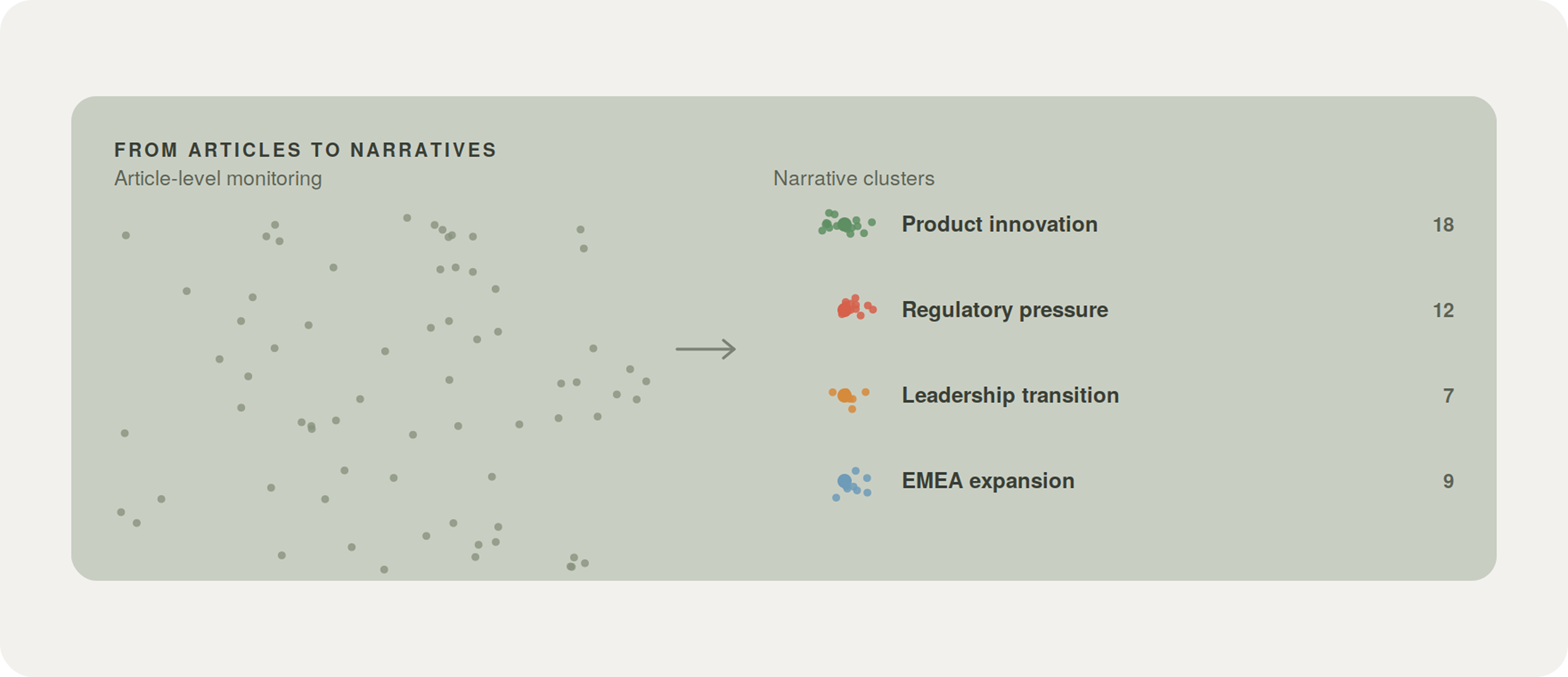
What shapes an AI system's opinion about a company?
AI-generated answers are influenced by a combination of factors.
Earned media
Reporting from credible publications provides independent evidence about a company's actions, performance, leadership, products, and reputation.
Earned media is particularly important because it does not originate from the company itself. It gives AI systems third-party validation for claims that might otherwise appear promotional.
Brand-owned content
Corporate websites, press releases, executive commentary, research, product pages, investor materials, and other first-party sources help establish the facts a company wants associated with its brand.
Owned content is most effective when it is specific, authoritative, consistent, and supported by outside evidence.
Repetition and consistency
Claims that appear repeatedly across multiple credible sources are more likely to become durable parts of the company's perceived identity.
Inconsistent messages make it harder for both people and AI systems to understand what a company stands for.
Source authority
Not all sources carry equal weight.
A detailed story from a highly credible publication may have more influence than dozens of low-quality mentions. AI systems may also favor sources that are closely aligned with the specific question being asked.
Factual specificity
Concrete evidence is easier to retrieve and summarize than broad marketing language.
Customer examples, measurable results, executive quotations, product capabilities, research findings, regulatory decisions, and clearly defined business initiatives provide stronger evidence than generic claims such as "industry-leading" or "innovative."
Brand prominence
An article that meaningfully discusses a company is more useful than an article that mentions it once in passing.
Prominence helps determine whether a source truly supports a claim about the brand or merely includes the company incidentally.
Freshness
Recent information can change how AI systems interpret a company, particularly during product launches, leadership transitions, earnings cycles, litigation, crises, regulatory events, and other fast-moving situations.
Competing narratives
AI systems must often reconcile conflicting evidence.
A company may describe itself as an AI leader while recent coverage portrays it as falling behind. A brand may promote affordability while journalists focus on price increases. A business may announce a transformation while analysts question whether the strategy is working.
The strongest and best-supported narrative is more likely to shape the answer.
Why prompt monitoring is not enough
Many AI visibility platforms begin by creating a list of prompts and repeatedly asking models those exact questions.
That can provide a useful observation of what a model said at a particular moment. But it does not reveal the full system shaping AI perception.
A company cannot predict every question that customers, employees, investors, journalists, regulators, partners, or competitors might ask.
Even small changes in wording can produce different answers. Results can also vary by model, timing, retrieval behavior, geography, available sources, and recent events.
Most importantly, monitoring an answer does not fully explain why the model produced it.
To shape AI perception, a company must understand:
Which narratives are forming around the brand
Which claims are becoming durable
Which sources are reinforcing those claims
Which articles are repeatedly appearing in citations
How different AI systems interpret the same narrative
Where perception is inaccurate, incomplete, or vulnerable
What the company should amplify, clarify, counter, or create
The prompt is only the visible output.
The narratives and evidence underneath it are the real system.
For a deeper look at the limits of answer sampling, see why prompt monitoring alone is not enough for AI reputation intelligence.
SEO, GEO, prompt monitoring, and AI perception intelligence
| Discipline | Primary question |
|---|---|
| SEO | Does our webpage rank in traditional search? |
| GEO | Is our company visible or cited in AI-generated answers? |
| Prompt monitoring | What did an AI model say when we asked a specific question? |
| AI perception intelligence | Which narratives, claims, and sources are shaping what AI systems believe about us? |
Traditional SEO remains important. Companies still need technically accessible, authoritative, useful content.
GEO expands that objective into generative answers.
But companies managing major brands need to go further. They need to understand not only whether they appear, but how they are interpreted, which evidence shapes that interpretation, and what communications actions can improve it.
Why communications should lead AI brand perception
Marketing and SEO teams have important roles in AI visibility, particularly around owned content and search performance.
But communications teams manage many of the inputs that most strongly influence brand perception:
Earned media
Corporate narratives
Executive positioning
Message pull-through
Issues and crisis response
Third-party validation
Reputation risk
Competitive positioning
Journalist relationships
Authoritative evidence
Communications has always influenced how stakeholders understand a company. Handraise’s AI Brand Perception and Narrative Intelligence capabilities are built for this shift.
The difference is that AI systems are now another stakeholder, one that continuously reads, retrieves, interprets, and summarizes the information environment surrounding the brand.
This makes AI brand perception a natural extension of modern communications strategy.
A five-step framework for shaping AI brand perception
Identify the narratives that matter. Start with the company's most important business priorities. These may include innovation, market leadership, trust, affordability, safety, growth, executive credibility, product differentiation, regulatory standing, employer reputation, or expansion into a new category. The objective is not to monitor every possible prompt. It is to define the narratives that materially affect the business.
Measure current human and AI perception. Analyze how the company is positioned across recent coverage and how major AI systems interpret those same narratives. Look for alignment and divergence. A narrative may be performing well in earned media but poorly represented in AI answers. An AI system may overemphasize an outdated controversy. A competitor may be receiving more credit for a category the company believes it owns.
Identify the claims and sources driving perception. Determine which claims are most likely to become durable AI beliefs. Then identify the publications, articles, corporate materials, and other sources reinforcing those claims. This should include both likely influence and observed citation behavior across repeated tests.
Decide what to amplify, clarify, counter, or create. Turn the analysis into communications action.
Measure how perception changes. AI perception is not static. Track changes across the metrics below. The objective is not to force every AI system to repeat a marketing message. It is to build an information environment in which the most accurate, credible, and strategically valuable interpretation of the company is also the best-supported interpretation.
In practice, the amplify / clarify / counter / create agenda looks like this:
Amplify favorable narratives supported by credible evidence.
Clarify narratives that are accurate but incomplete.
Counter inaccurate or damaging claims with stronger facts.
Create authoritative content where important information is missing.
Strengthen third-party validation where owned content is insufficient.
Give journalists and stakeholders clearer evidence they can reference.
Track changes in:
Narrative presence
Favorability
Brand positioning
Message pull-through
Source authority
Citation frequency
Citation confidence
Cross-model consistency
Competitive positioning
Narrative drift
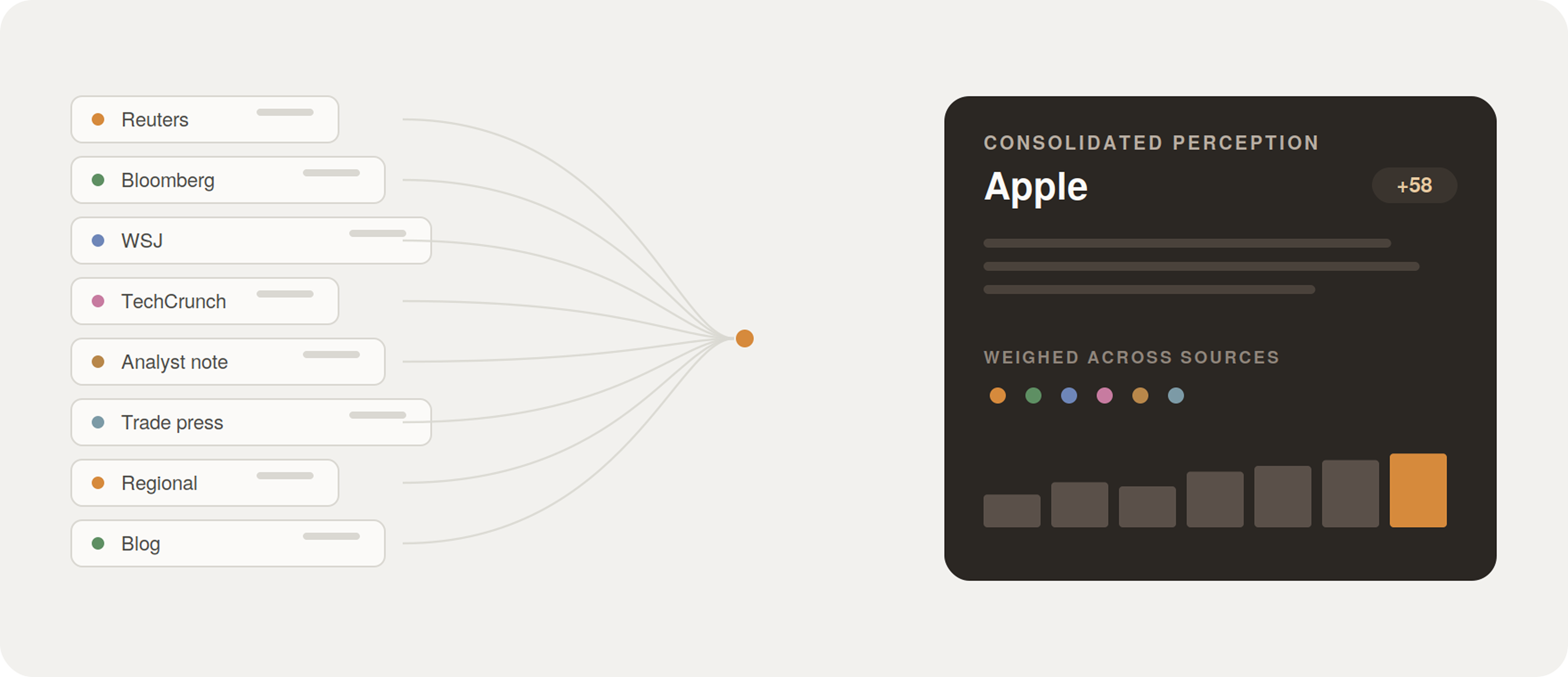
Earned media is becoming part of AI infrastructure
Earned media has traditionally influenced what people know and believe about a company.
It now also influences the systems people use to find and interpret information.
A high-quality article can do more than reach the publication’s immediate audience. It can become supporting evidence for future AI answers about the company, its products, its leadership, and its industry. That is why media monitoring and measurement remains foundational even as teams expand into AI perception.
This changes how communications teams should evaluate coverage.
The value of a story is no longer limited to readership, impressions, sentiment, or social engagement.
Teams must also consider:
Does the story reinforce an important narrative?
Does it contain clear and retrievable claims?
Is the company meaningfully prominent?
Is the source authoritative for the subject?
Is the article likely to influence future AI answers?
Is it being cited by AI systems?
Does it improve or weaken the company's position relative to competitors?
The best communications strategies will increasingly optimize for both human and machine interpretation — including competitive intelligence and risk and crisis intelligence when narratives turn adverse.
From media monitoring to narrative intelligence
Traditional media monitoring was built to answer a simpler question:
“Where was our company mentioned?”
That is no longer enough.
Communications leaders need to understand what the coverage means, which narratives are forming, how those narratives affect reputation, how AI systems interpret them, and what the organization should do next.
The future is not another dashboard filled with article counts.
It is a system of intelligence that connects:
Earned media
Narrative analysis
Human stakeholder perception
AI perception
Citation intelligence
Competitive positioning
Strategic communications action
Handraise’s platform and daily briefings are designed to help teams act on that system every day.
The companies that understand this system will have a meaningful advantage.
They will not merely monitor what AI says.
They will understand why it says it and how to shape what it says next.
In summary
AI systems form brand opinions from narratives, claims, and authoritative sources—not from any single prompt. Communications teams that measure that narrative layer can decide what to amplify, clarify, counter, or create.